



ELIDREO Technology
Innovative biomonitoring through standardized bioassays
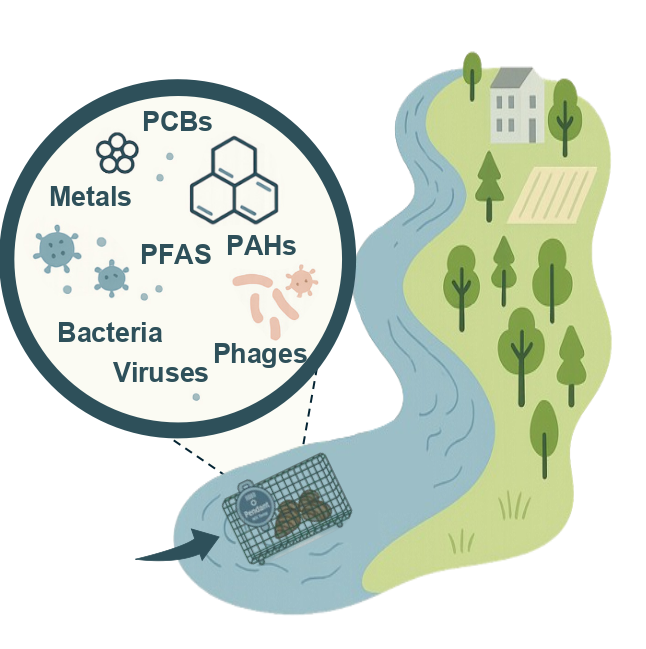
At ELIDREO, we use zebra mussels to detect pressures exerted on the aquatic environment, whether chemical or microbiological.
ELIDREO offers water sector stakeholders an innovative bioassay based on calibrated zebra mussels (Dreissena polymorpha) for water quality biomonitoring.
We manage all stages: from the production of calibrated organisms to deployment and retrieval of bioassays in the field, through to interpretation of results.
Toxicity effects of water, assessed via measurement of ecotoxicity biomarkers, are performed in-house. Analyses of microbiological endpoints and micropollutants in zebra mussel tissues are conducted by our specialized partners.
Technical process
Production of Standardized Organisms
Production
Zebra mussels are sourced from a naturally occurring population, carefully identified and characterized.
Acclimatization
Zebra mussels are maintained for several weeks in the laboratory under controlled conditions. Regular chemical and baseline microbiological contamination checks are performed (quality control).Parameters monitored: temperature, feeding, oxygen, pH, conductivity, nitrates, nitrites.
Bioassay Deployment Phase
Calibration
They are then calibrated by size and placed in cages at least one week prior to deployment. It is possible to separate organisms by sex (♂/♀).
Deployment
Zebra mussels are exposed to water either directly in the environment (in situ) or via an ex situ exposure box.
The standard bioassay duration is 3 weeks for chemical analyses and 1 week for microbiological analyses.
Exposure time can be adjusted depending on specific use cases.
Recovery
At the end of exposure, zebra mussels are retrieved and their tissues sampled for analysis.Analyses and Interpretation
Analyses
The endpoints defined with the client are analyzed: chemistry, microbiology, biomarkers.
Interpretation
Results are analyzed and an expert report is delivered to the client.
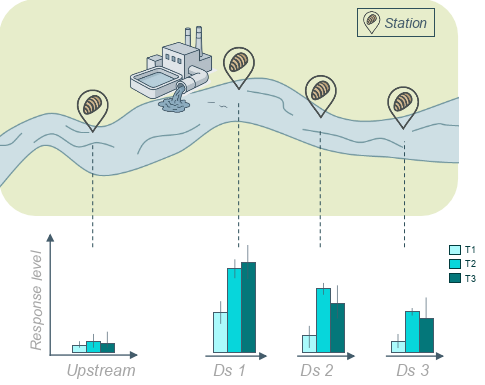
Internal interpretation grids, upstream/downstream comparison, comparison with biotic environmental quality standards.
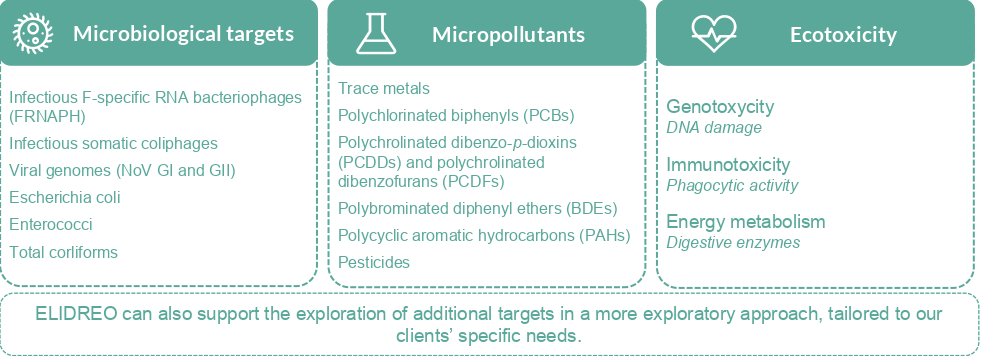
Measurable endpoints in zebra mussels
Almost 140 chemical compounds can already be detected in the tissues of Dreissena polymorpha, thanks to developments carried out at the UMR-I 02 SEBIO laboratory (University of Reims Champagne-Ardenne) and research projects supported by water agencies.
In addition, the zebra mussel bioassay is the first biomonitoring tool to integrate the assessment of microbiological contamination of water. For microbiological analyses, ELIDREO relies on the expertise of ACTALIA laboratories, specialized in microbiological safety and recognized for supporting agri-food and environmental stakeholders in sanitary quality control.
Aquatic environment monitoring
The zebra mussel bioassay was developed to address water monitoring challenges:
In this context, exposure duration is standardized:
- Microbiological endpoints: 1 week
- Micropollutants: 3 weeks
- Biomarkers: 3 weeks
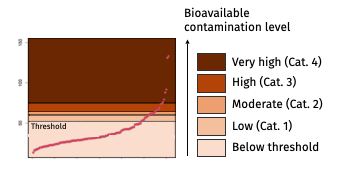
Interpretation of analytical results for bioaccumulation (microbiology and micropollutants) as well as for ecotoxicity biomarkers is provided by ELIDREO.
- Comparison with Environmental Quality Standards for biota (NQE biote), for micropollutants with established reference values
- Interpretation using our internal grids, available for certain micropollutants and ecotoxicity biomarkers
Other use cases
The zebra mussel bioassay can also be used to address questions related to other use cases:

For each use case, the application can be carried out in accordance with the water body monitoring strategy, or adapted to meet the specific constraints or contexts of each situation:
- Exposure duration: Duration can be adjusted, and sequential recovery may be implemented to ensure temporal monitoring of an event.
- Exposure mode: Zebra mussels can be exposed directly in the environment (in situ) or via an ex situ exposure box.
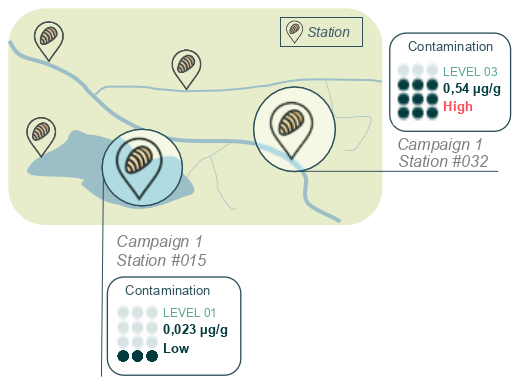
Interpretation of bioaccumulation (microbiology and micropollutants) as well as biomarkers is based on a strict upstream/downstream comparison (e.g., upstream/downstream of discharge, upstream/downstream of treatment…).